blog post
Built to Last: Designing High-End Children’s Suites that Evolve from Toddler to Teen
Here is a conversation that happens in a lot of homes, usually around the time the child turns seven or eight.
The parents look at the room they spent so much on — the whimsical cloud wallpaper, the pastel furniture, the little train-shaped bookshelf — and they realize it already feels dated. The child has moved on. The room has not.
So they redo it. And five years later, when the teenager starts expressing strong opinions about everything from color to privacy, they face the same problem again.
This is not a design failure. It is a planning failure. A child's room does not need to be redesigned every few years — it needs to be designed once, but designed intelligently. A suite that absorbs change rather than resists it. A space that grows as your child does.
This kind of thinking is exactly what the best interior designers in Gurgaon do when they approach children's rooms differently from the rest of the home. And it is what this blog is about.
Why Most Children's Room Designs Age Out Too Fast
The instinct when designing a child's room is to make it exciting and age-appropriate right now. Bright primary colors. Character-themed murals. Furniture sized for small bodies. All of it makes perfect sense for a four-year-old.
But here is the problem: most of these choices are fastened to a very specific moment in time. The moment passes, and suddenly you have a twelve-year-old who is embarrassed by the cartoon on their wall and a bed frame that needs replacing because it no longer fits them.
The average family in a high-end residential complex in Gurgaon will redesign their child's room two to three times between birth and the age of eighteen. Each redesign comes with costs — not just financial, but the disruption of the child's space, the waste of materials that are pulled out after just a few years, and the cognitive load of starting from scratch.
The luxury interior designers in Gurgaon who have worked through this problem repeatedly know there is a better architecture for this room. It starts with separating what should stay from what should change.
The Framework: Permanent Bones, Flexible Surface
The secret to a children's suite that lasts is designing in two layers.
The permanent layer consists of things that do not need to change as the child grows: the flooring, the built-in storage and shelving structure, the lighting infrastructure, the ceiling treatment, and the spatial layout itself. These are executed in materials and designs that are timeless, quality-grade, and sophisticated enough to work for a teenager just as well as they do for a toddler.
The flexible surface layer consists of everything that can be swapped, updated, or removed without touching the bones: bed linen, cushions, rugs, artwork, the child's own collected objects, perhaps a feature wall that uses paint or panels rather than permanent wallpaper.
When luxury interior designers in India approach children's suites this way, the room simply absorbs change. The toddler phase gets its color and playfulness through easy-to-update elements. The school-age phase needs more storage, better task lighting, and a proper study area — all of which can be adapted without tearing out the structure. The teenage phase needs privacy, personal expression, and a room that does not feel childish — which is achieved by editing the surface layer rather than demolishing and rebuilding.
This is also why the quality of the permanent layer matters so much. If you build it right the first time — solid wood joinery, quality flooring that ages well, wiring for lighting scenarios you will need later — you save significantly over the long run. Cheap materials in the permanent layer will need replacing anyway, and that replacement coincides with the room no longer being suitable for the child's age. You end up doing two jobs at once.
What Goes Into Each Stage of a Well-Designed Children's Suite
Let us get specific about how this actually plays out across the three major phases of childhood.
The Toddler-to-Early-Childhood Phase (Ages 0–6)
The priorities at this stage are safety, sensory richness, and floor space. Children at this age spend enormous amounts of time on the floor. They need rounded edges, non-toxic materials, soft surfaces, and enough open space to move and play.
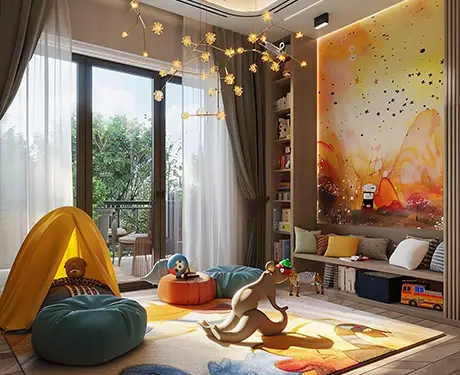
For the permanent layer, this means: cork or quality wood flooring with a large area rug, built-in low shelving that works perfectly as toy storage now but transitions seamlessly to books and display later, and overhead lighting on a dimmer so the room can shift from bright play-space to quiet sleep environment without the child needing to process a jarring change.
For the flexible layer: a cot or low bed, soft toys, colorful storage bins, a mural that uses removable wallpaper or a chalk-paint feature wall that the child can actually draw on.
The Middle Childhood Phase (Ages 7–12)
This is the phase most parents underinvest in. By this age the child has outgrown the infant room but is not quite a teenager, so the redesign feels optional. It is not. This is when children start doing substantial homework, developing specific interests, and wanting a room that reflects their personality.
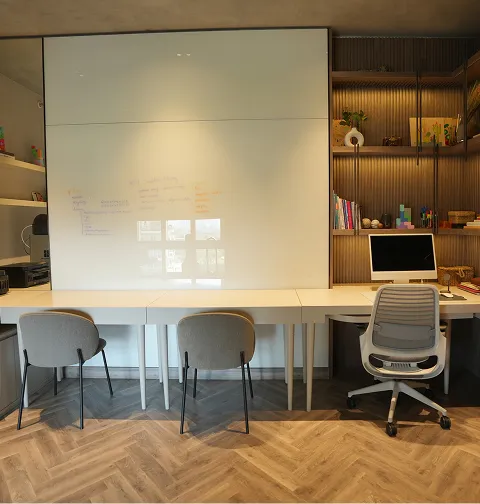
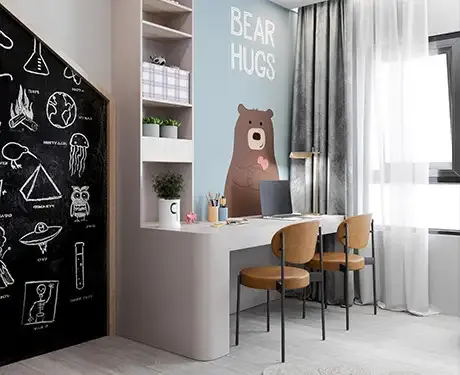
The priorities here shift to: a proper, ergonomically considered study zone with real task lighting (not just a desk lamp balanced on the shelf), adequate storage for school materials, sports gear, and hobbies, and a bed that has grown with the child to a full single or larger.
In a well-designed suite, the transition here is minimal. The shelving already accommodates books. The lighting infrastructure supports adding a focused task fixture. The furniture scaled for this phase can be swapped without touching the walls or floors. What changes is the edit — and this is where the best interior designers in Gurgaon earn their fee by knowing exactly what to keep and what to move on from.
The Teenage Phase (Ages 13–18)
By the time your child is a teenager, their room is not a children's room anymore. It is, effectively, a small apartment within the home. They need privacy, a space for their social life, a proper workspace, and an environment that respects their emerging sense of identity.
The non-negotiables at this stage: acoustic consideration (a teenager's room at 10 pm should not disturb the rest of the house), a study zone that works for extended hours, wardrobe storage that has grown with their wardrobe, and a visual language that does not feel juvenile.
Again, in a suite that was designed with this evolution in mind, most of this is already in place. The bones are right. What changes are the surfaces: the rug, the bed linen, perhaps the color of the feature wall, and the artwork. The teenager can have meaningful input into these decisions, which is itself a healthy part of the process.
The Materials That Make This Work
When Interia's team designs a children's suite with longevity in mind, material selection is one of the most consequential decisions. Here is what that looks like in practice.
For flooring, engineered hardwood or quality laminate with an appropriate hardness rating. Soft enough to be comfortable, durable enough to handle two decades of foot traffic. Natural wood tones age beautifully and never feel childish.
For built-in joinery, solid wood or high-grade MDF with a finish that can be repainted or re-veneered if the aesthetic needs updating. The joinery itself — the structure, the shelf positions, the hardware — should be built to last.
For walls, a neutral, high-quality paint base on most surfaces. One feature wall that is deliberately designed to be changeable: a chalk surface, a magnetic panel, a section finished with wallpaper that can be removed cleanly when the child outgrows the print.
For lighting, a ceiling rose with adjustable downlights on a dimmer, plus a bedside circuit and a dedicated desk circuit. This is the infrastructure that allows the room to be re-lit appropriately for each stage without rewiring.
Why Interia Gets This Right Where Others Fall Short
Designing a children's suite that genuinely evolves requires two things that are hard to find in combination: creative vision and technical precision. The vision to imagine the room across fifteen years of a child's life, and the precision to execute permanent elements that actually hold up across that span.
What makes Interia one of the most trusted luxury interior designers in India is the combination of in-house manufacturing and end-to-end project management. Custom furniture is produced at Interia's own facility, which means tolerances are tighter, material grades are verified, and the joinery is built for actual longevity — not just for the photoshoot. The firm's single point of contact model means that when parents return three years later to update a surface element, the relationship continues seamlessly. There is no starting over with a new vendor who does not know the room.
Interia has won Asia's Property Awards for Best Interior Design Company and India's Most Prominent Architects & Design Awards for Best Interior Design Company in Delhi NCR — recognition that reflects not just design skill but consistent delivery at a level that discerning clients trust.
Design a Room Your Child Will Still Love at Eighteen
A children's suite is one of the most intimate rooms in the home. It is where your child sleeps, learns, plays, recovers from hard days, and slowly figures out who they are. It deserves more than a coat of paint and some themed furniture replaced every few years.
When you work with luxury interior designers in Gurgaon who understand this room across its full lifespan, you get something genuinely different: a space that holds meaning and function at every stage, built from materials that stand up to real life, and designed with an honesty about what your child will need not just today but in a decade.
Interia's team has designed children's suites for some of Gurgaon and Delhi NCR's most discerning families. The conversation starts with your child — their age, their temperament, their world — and builds outward from there.
Start the conversation with Interia today — call or visit theinteria.com to schedule a consultation.
Q: What is the ideal time to commission a future-proof children's suite — before or after the baby arrives?
Ideally, during the pregnancy or in the first year. This gives the design team time to execute the permanent layer properly without rushing. The flexible surface layer can evolve with the child from the start.
Q: How much more does a future-proof suite cost compared to a standard children's room design?
The permanent layer costs more upfront — perhaps 30–40% more than a basic room — but eliminates the need for two or three complete redesigns over fifteen years. Most clients find the total cost of ownership significantly lower, in addition to the quality advantage.
Q: Can Interia design a suite for a child who already has an existing room that feels outdated?
Absolutely. Interia's team assesses what is worth retaining (usually the structural elements if they are quality-grade) and what needs replacing. In many cases, a room can be transformed for the next phase without a full strip-out.
Q: What size room do you need for a proper children's suite?
A meaningful suite can be executed in rooms from 150 square feet upward. The design principles apply regardless of size — what changes is the configuration, not the approach.
Q: Does Interia work on children's rooms specifically, or is this part of a larger home project?
Both. Interia takes on full-home projects as well as individual room commissions. Children's suites often work best when designed as part of the overall home, since the aesthetic should connect coherently — but standalone room projects are equally welcome.