blog post
Moroccan Rugs Meet Madhubani Art: Mastering the Global Fusion Interior Style
There is a unique kind of magic that happens when you stop decorating by the book and start decorating by the heart. In the world of high-end residential design, we meet a magnificent departure from the sterile, one-note aesthetics of the past. Today, the most captivating homes in India aren't just modern; they are "Global Fusion" masterpieces, mastering the art of blending diverse styles seamlessly.
At Interia, we have witnessed a growing desire among homeowners to blend the soulful, geometric grit of the Atlas Mountains with the intricate, spiritual storytelling of the Mithila region. Specifically, the pairing of Moroccan Rugs and Madhubani Art has emerged as a gold standard for sophisticated eclecticism.
But how do you marry a North African tribal weave with an ancient Bihar folk tradition without the room feeling like a chaotic bazaar? It requires more than just good taste; it requires a grasp of architectural design and a strategic eye for balance. This is where turnkey interior solutions come into play, providing a seamless approach to integrate diverse styles while maintaining harmony throughout the space.
The Philosophy of Global Fusion
Global Fusion is not about clutter; it is about "Curated Contrast." It’s the art of finding common threads between seemingly unrelated cultures.
Moroccan rugs, particularly the Beni Ourain or Azilal styles, are celebrated for their plush textures and abstract, often asymmetrical geometric patterns. Madhubani art, on the other hand, is defined by its vibrant natural pigments and dense, symbolic line work that leaves no space empty.
The commonality? Both are handmade, deeply symbolic, and celebrate the "perfect imperfection" of the human hand. When you integrate these through turnkey interior solutions, you create a space that feels layered, traveled, and profoundly personal.
1. Grounding the Space with Moroccan Textures
A room is only as good as its foundation. In a fusion interior, the rug acts as the anchor that ties the architectural elements together.
- The Neutral Canvas: A high-pile, cream-and-charcoal Beni Ourain rug provides a soft, neutral base. This allows the intricate, often colorful details of Madhubani paintings to pop without overwhelming the visual field.
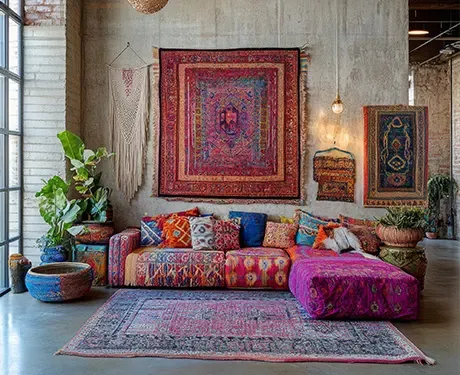
- The Color Play: If you are feeling bold, a vibrant Azilal rug with flashes of pink and turquoise can mirror the vivid hues found in Bharni style Madhubani art.
- Tactile Contrast: Place the rug on a sleek floor: think large-format grey tiles or dark walnut hardwood. This architectural contrast between the "slick" and the "shaggy" is a hallmark of top interior designers in India.
2. Madhubani Art as an Architectural Statement
Madhubani art is traditionally a mural art, painted on the mud walls of huts. In a modern luxury context, we translate this into a sophisticated focal point.
The "Statement Wall" Approach
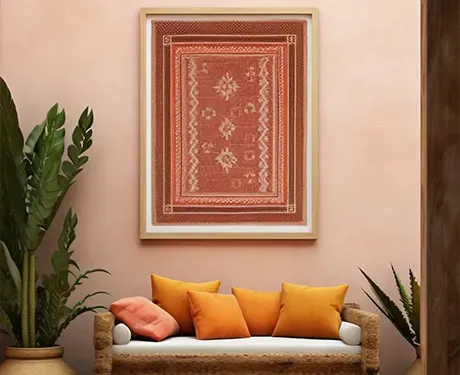
Instead of small, scattered frames, consider a single, oversized Madhubani canvas. Whether it’s the Kohbar (the traditional bridal chamber motif) representing fertility or a majestic Tree of Life, the art should command the wall.
Pro Tip: Use contemporary framing: think slim black metal or shadow boxes. This "modernizes" the folk art, making it fit seamlessly into a home with clean architectural design lines.
Beyond the Frame
As a provider of turnkey interior solutions, Interia often integrates Madhubani motifs into unexpected places:
- Custom Cabinetry: Hand-painted Madhubani shutters on a bar unit.
- Ceiling Details: Subtle line-art decals in a tray ceiling to add vertical interest.
- Textile Fusion: Madhubani-printed silk cushions resting on a low-slung Moroccan sofa.
3. The Architectural Bridge: Arches and Lighting
To truly master this style, you must look at the "shell" of the room. Moroccan architecture is famous for its horseshoe arches and keyhole doorways. Madhubani art is famous for its lack of empty space.
- Softening the Lines: If your home has sharp, modern angles, introduce a soft Moorish arch in the transition between the living and dining rooms. This mimics the organic curves found in Madhubani bird and fish motifs.
- Lighting as a Catalyst: Use Moroccan filigree lanterns (pierced metal) to cast "patterned shadows" across your Madhubani pieces. This creates a 3D effect, making the flat folk art feel alive and immersive.
Why Turnkey Solutions are Vital for Fusion Projects
Fusion design is a high-wire act. One wrong move and the home goes from "curated" to "cluttered." This is why homeowners seek out top interior designers in India who offer turnkey interior solutions.
When one team handles everything, from the initial architectural design sketches to sourcing authentic Berber rugs from Marrakesh and commissioning National Award-winning Madhubani artists from Bihar, the result is a cohesive narrative. You don't just get a house; you get a story where every thread and brushstroke is intentional.
Your Home is a Canvas—Let’s Paint It Together
The fusion of Moroccan rugs and Madhubani art is more than a trend; it is a celebration of human heritage. It is about creating a space that feels as global as your outlook and as rooted as your soul.
At Interia, we specialize in these complex, beautiful intersections. Whether you are starting with a blank slate or looking to infuse your current space with global character, our team is ready to turn your vision into a living masterpiece.
Ready to start your Global Fusion journey?
Frequently Asked Questions (FAQs)
Q1: Can I use Madhubani art in a minimalist home?
Yes. Look for "Kachni" style paintings, which are predominantly black and white line work. They offer incredible detail without the visual weight of heavy colors, fitting perfectly into a minimalist or "Japandi" aesthetic.
Q2: Are Moroccan rugs hard to maintain in Indian climates?
Authentic wool rugs are surprisingly resilient. Wool contains natural lanolin which resists stains. Regular vacuuming and professional cleaning once a year are usually enough. For high-humidity areas, ensure good ventilation to keep the wool fresh.
Q3: How do I know if a Madhubani painting is authentic?
Authentic Madhubani art is often done on handmade paper or canvas using natural dyes (like turmeric for yellow or indigo for blue). Look for the "Artist’s signature" and the specific style (Bharni, Kachni, or Tantrik). Buying from reputable top interior designers in India ensures you are supporting genuine artisans.
Q4: Does Interia help in sourcing these specific pieces?
Yes. Our turnkey interior solutions include the procurement of global decor. We have a network of international vendors and local master-craftsmen to ensure every piece in your home is authentic and high-quality.