blog post
From Gurgaon Bungalows to Bangalore Villas. What 15 Years of Interior Design Across India Taught Interia
Fifteen years ago, setting up a luxury home in India meant navigating a completely different landscape. Homeowners typically hired a local contractor, visited stone yards to guess how a slab of marble might look under different lights, and crossed their fingers that the custom carpentry would fit together properly.
When Interia started designing premium spaces a decade and a half ago, the mission was to change that uncoordinated process into an absolute art form.
Since then, the firm has had the privilege of designing everything from sprawling multi-generation family bungalows in Gurgaon’s DLF Phase 1 and Golf Course Road to sleek, tech-forward lakeside villas in Bangalore's Whitefield and Sarjapur. Moving across these diverse regional topographies taught the team that luxury isn’t a fixed aesthetic formula. True luxury is local, deeply functional, and entirely about how a family interacts with their immediate environment.
Here is what fifteen years on the ground as one of the leading interior designers in India has taught the company about building homes that stand the test of time.
Key Takeaways from 15 Years of National Design
- Luxury is Regional, Not Universal: A design that works flawlessly in the dry, intense heat of Delhi NCR will fail in the humid, tropical climate of Coastal or South India if the materials aren’t carefully adapted.
- Micro-Cultures Dictate Spatial Layouts: The way a family hosts guests in a Gurgaon bungalow (often involving grand, formal entertainment zones) looks very different from how a Bangalore villa owner utilizes space (prioritizing semi-private, indoor-outdoor garden transition zones).
- Execution Infrastructure Trumps Mood Boards: A beautiful 3D concept drawing is only as good as the factory-grade machinery and civil engineering backing it up on-site.
- The Invisible Bones Matter Most: The absolute marker of a premium space isn't the flashy wallpaper; it’s the flawless waterproofing, acoustic dampening, and dust-sealing hidden behind the walls.
The North vs. South Shift: A Tale of Two Micro-Climates
When working as a top-tier interior design company in India, a team quickly realizes that the biggest collaborator—and occasional adversary—is the local weather.
In Gurgaon and the wider Delhi NCR, homes have to withstand massive environmental extremes. Properties deal with blistering 45°C summers, sharp winter drops, and intense dust storms. Because of this, luxury homes in the North lean heavily toward solid, high-thermal-mass materials. Interia frequently specifies heavy, deeply veined Italian marbles like Grigio Carnico or Michelangelo white, paired with insulated false ceilings to reduce air conditioning loads, and high-performance UV-resistant textiles that won't fade under the harsh afternoon sun hitting large glass fronts.
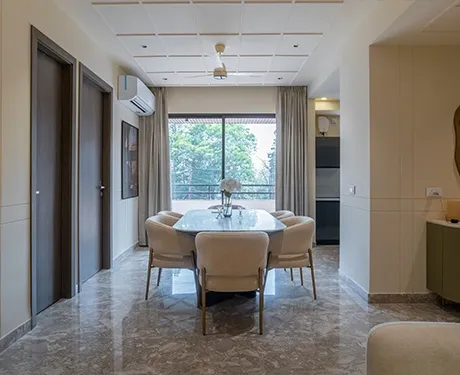
Conversely, a premium Bangalore villa exists in a climate that is notoriously gentle but experiences consistently higher humidity. Wood behaves differently here; solid timber planks can cup and warp if they aren't engineered correctly. For South Indian projects, the design strategy shifts toward highly stable engineered hardwoods, breathable natural stones like Kota or premium granites, and open architectural layouts. Bangalore homes want to breathe. The design language shifts away from heavy drapes and sealed enclosures toward massive sliding pocket doors, louvers, and interior courtyards that let the gentle evening breeze move freely through the house.
How Social Rituals Shape Interior Architecture
A house should never force a family to adapt to its structure; the structure must mirror the family's social habits. Over 15 years, Interia has observed a fascinating contrast in how space is valued across different regions.
The Northern Bungalow: The Art of Hospitality
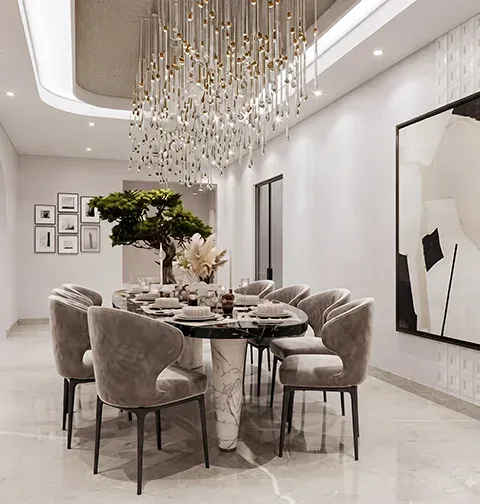
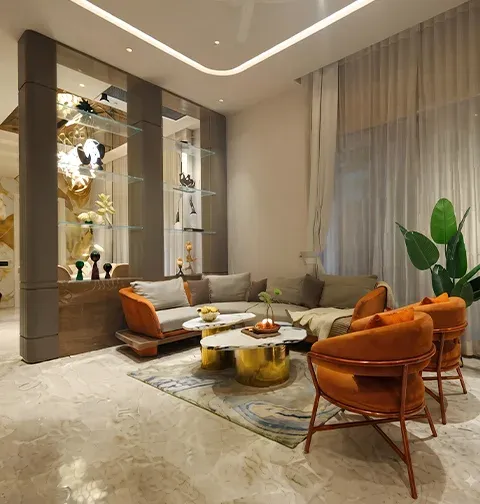
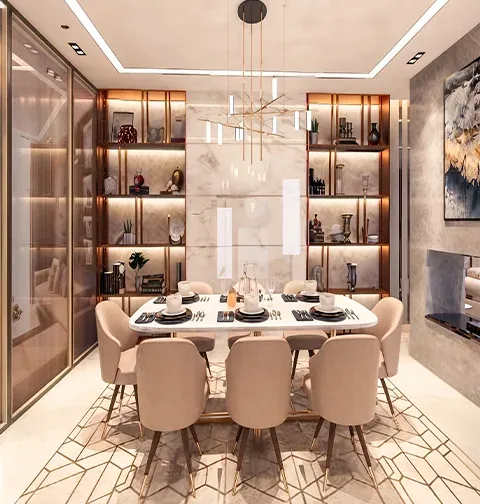
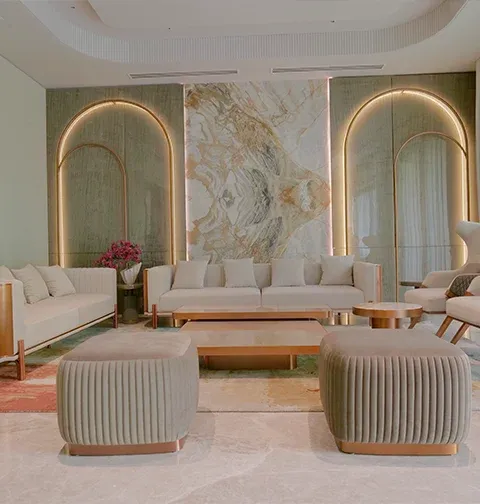
In the North, residential design frequently centers around grand-scale entertaining. Homeowners look for double-height living rooms, formal dining halls that comfortably seat twelve or more, and separate, dedicated lounge bars where business associates or large extended families can gather privately. The materials are intentionally striking—featuring accent walls crafted from backlit onyx, custom metal screens in brushed brass, and statement chandeliers that anchor the entire room.
The Bangalore Villa: The Indoor-Outdoor Sanctuary
In Bangalore, the luxury aesthetic is far more understated, focusing heavily on personal wellness and nature. The formal living room is often kept intentionally compact, while the design budget is channeled into massive, semi-covered verandahs, deck spaces, and double-height family lounges that open directly into private lawns. It’s a culture centered around slow mornings, filter coffee, and hybrid work-from-home routines. The materials here are highly tactile and earthy—terracotta accents, micro-concrete finishes, muted ash wood, and an abundance of integrated indoor greenery.
Moving Past Catalog Architecture: Why In-House Manufacturing Wins
In its early years, like most boutique firms, Interia sourced custom furniture from various high-end third-party workshops. However, experience quickly showed that outsourcing luxury creates unpredictable results. A wardrobe door built in a non-temperature-controlled environment would expand three months later, or a premium kitchen laminate would begin to delaminate at the edges due to moisture.
To become one of the best interior designers in India, the company realized it had to control the entire supply chain.
Interia invested heavily in its own state-of-the-art manufacturing facility. Now, whether building a walk-in wardrobe for a penthouse in Gurgaon or a minimalist floating media console for a villa in Bangalore, every single panel is cut on high-precision German CNC machinery. The edges are laser-banded to completely seal out moisture, and the finishes are applied in dust-free lacquer rooms.
This level of control means that when the installation team arrives at a site—no matter where it is in India—the components fit together down to the exact millimeter. There is no messy, noisy carpentry work happening on pristine floors, and handover timelines are guaranteed.
Common Mistakes Homeowners Make When Chasing Global Trends
Having remodeled numerous dated properties over the last decade and a half, Interia constantly sees homeowners fall into the same traps when trying to replicate international design trends seen online:
- Blindly Copying European Open-Kitchen Templates: A completely open kitchen looks beautiful in a Nordic apartment, but it can quickly backfire with traditional Indian cooking. The intense spices and oils can end up coating luxury living room fabrics. Interia solves this by designing smart wet-and-dry kitchens—a pristine, minimalist outer dry kitchen for quick breakfasts and entertaining, backed by a fully enclosed, heavy-duty wet kitchen with industrial exhaust systems for actual cooking.
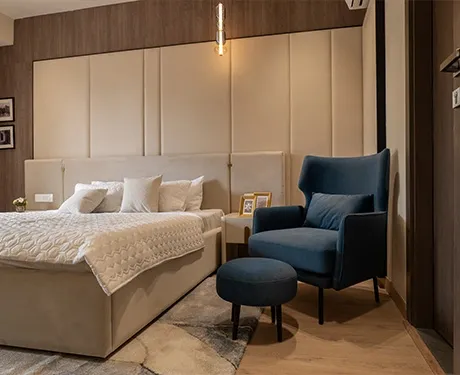
- Neglecting the Acoustic Reality of Hard Floors: Large-format marble or polished concrete looks magnificent, but if the walls and ceilings are also hard, flat surfaces, the home will echo like an empty hall. Designers integrate subtle sound-softening solutions early on—such as acoustic wood paneling, fabric-wrapped headboards, and custom-woven carpets to keep conversations quiet and intimate.
- Underestimating Wardrobe Ergonomics: People often focus entirely on the exterior finish of a wardrobe door while ignoring the layout inside. True luxury is having drawers configured to the exact height of watches, jewelry, or custom suits, accompanied by integrated LED lighting that switches on automatically when the door glides open.
Looking to the Future: The Next Chapter of Indian Living
As the industry looks ahead, the defining trait of premium Indian homes will be smart, invisible resilience. Today's luxury homeowners want spaces that look effortless but work incredibly hard. Interia is increasingly integrating home automation systems that manage energy use, water filtration systems that protect high-end bathroom fixtures from hard water damage, and circadian lighting setups that mimic natural daylight shifts inside the home.
Ultimately, a fifteen-year journey across India has proven that a great home isn't built to impress onlookers; it is built to comfort the family living inside it. By honoring local weather realities, respecting how people actually move through a space, and refusing to compromise on the invisible technical details, it is possible to create homes that feel completely personal, effortless, and timeless.
Explore Interia’s 15-Year Anniversary Portfolio.
Schedule a Site Consultation with the Design Strategy Team.
frequently asked questions
The company operates with a highly synchronized business model. All core architectural planning, 3D visualizations, and custom furniture manufacturing happen within Interia's centralized facility. Once the modular components are ready, they are securely shipped directly to the location. A dedicated Interia project management and installation team then takes complete control on-site, managing local vendors and executing the final handover to ensure identical, premium quality across India.
An independent designer provides a beautiful concept drawing, but often leaves the stressful task of finding reliable contractors, checking material quality, and managing timelines entirely on the homeowner's shoulders. A unified firm like Interia handles everything under one roof—from initial space planning and budget control to manufacturing and on-site civil execution—giving clients a completely stress-free experience with clear, single-point accountability.
For the internal carcass of kitchens and vanities in humid environments, Interia strictly avoids commercial particleboard or standard MDF. Instead, the firm utilizes high-density, moisture-resistant plywood or specialized boiling-water-proof (BWP) marine ply. This ensures the internal cabinetry remains perfectly rigid and completely free from termites, swelling, or mold growth over decades.
The ideal time to engage an interior design team is while the brickwork partitions are being planned, well before plumbing lines and electrical points are cast into the concrete. This allows the team to optimize the floor plan, position power outlets exactly where automation or lighting requires them, and ensure all flooring thresholds align perfectly flush without expensive structural rework later.