blog post
Maximizing Density: Smart Layout Strategies for High-Efficiency Start-up Offices
For the majority of start-ups, space is both an asset and a drawback. Teams are growing up fast, roles change overnight, and every square foot of the office is working harder than the last. This is just where smart spatial planning comes in. With the right layout strategies, maximizing every corner of a modest floor plate can make the office feel open, efficient, and energising - something every founder wants for their team.
As a fast-growing business office interior design company, Interia has seen firsthand how smart design decisions can transform productivity and employee happiness and create an extraordinary impact. Whether a start-up is working out of a condensed co-working-style unit or designing its first dedicated headquarters, the layout must be right, as it is non-negotiable. And with so many interior firms in Gurgaon speaking about optimisation, it takes more than stylish furniture to get things done for real efficiency. It involves thinking about density in a big way, about flow, and a kind of unique rhythm of starting up things.
In this blog, we unpack some practical, high-impact strategies for layout you could implement as a growing company to get the most out of your office space - without losing too much comfort, culture, or brand identity in the process.
Key Elements of High-Efficiency Office Design
1. Start By Having a Real Understanding of How Your Team Works
Designing for density is not about squeezing more desks into a room. It starts with getting insight into how your team actually behaves on an ordinary working day. How many people work as part of a team, and how many work alone? Is your team very mobile? What tools or spaces do they rely upon?
Start-ups often evolve fast, and what worked three months ago doesn't necessarily work today. Conducting some simple observation in the workplace or an informal team survey unveils some patterns to help plan smarter:
- Does the team like open discussion zones or the quiet corners?
- Are Meeting Rooms underutilised?
- Are there particular teams that need to interact with each other and require proximity?
This insight will make sure that your layout is natural rather than forced.
2. Use Zoning to Make Every Area Work Harder
Zoning is one of the most effective ways of increasing density without sacrificing comfort. Instead of a single open floor with overlapping chaos in the space, strategic zoning separates the space into functional sections, and areas are distinct and good for separate purposes.
Common high efficiency zones are:
- Collaboration Pods: Acoustic screens/glass partitions provide semi-private areas for brainstorming, and teams meet without using conference rooms.
- Heads-Down Focus Areas: Dedicated quiet corners help team members to switch off noise and concentrate when it is needed.
- Flexible Commons: A large central area that doubles as a lounge, town-hall space, workshop venue, or lunch zone gives start-ups maximum value for the square footage.
The best interior designers in Gurgaon often treat zoning as the backbone of efficient design, especially when working with space-tight start-up offices.
3. Adopt Modular and Multi-Functional Furniture
Furniture has a larger role to play in density management than most people realize. Modular systems provide unmatched adaptability - something which young companies desperately need.
Examples include:
- Desks that can be combined or separated depending on the size of the team.
- Foldable conference tables to vanish when floor space is required for functions or training
- Mobile whiteboards and storage units that can go where your work goes
- Seating without clutter, benching systems designed for as much seating as possible.
By making simple choices about what pieces to buy in terms of evolving with your team, you avoid the issue of building frequent renovations or reconfiguration costs.
4. Integrate Vertical Design to Release Floor Space
When horizontal space has become tight, look for space vertically. Vertical design strategies can greatly increase efficiency:
- Wall-mounted storage to minimise ground-level clutter.
- Tall shelving units to fit in equipment and documents.
- Vertical greenery installations that enhance aesthetics while not taking up floor space.
- Suspended lighting systems that take out the need for bulky floor lamps.
By adopting a taller visual design, your office is not only more open, but it has improved circulation.
5. Build Semi-Open Meeting Spaces in Place of Traditional Cabins
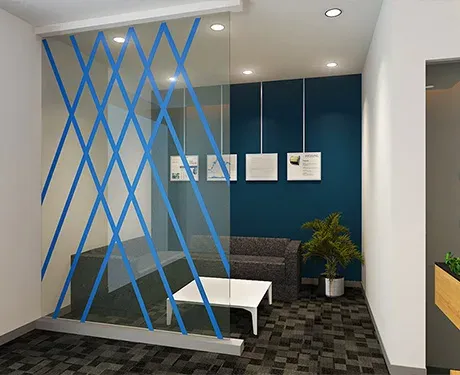
Fully enclosed cabins sometimes consume more space than is required. Semi-open meeting zones, achieved with glass, acoustic partitions, or even furniture set-up, provide a sense of privacy without the space of a large room.
These meeting points are perfect for:
- Quick stand-ups
- Sales calls
- Project discussions
- Small group huddles
The transparency also helps to keep a visual connection throughout the office, which promotes openness and teamwork - two hallmarks of start-up culture.
6. Keep Traffic Lanes Clear to Promote Flow
Density should not occur at the expense of movement. Poor layouts tend to result in obstructed walkways and awkward changes of direction, and bottlenecks. To avoid this:
- Make sure to provide good access to all desks.
- Have separate entry and exit points for zones.
- Place high traffic items - printer, storage, pantry - at accessible but non-intrusive locations.
- A streamlined flow helps to make employees feel less congested and in control of their environment.
7. Use Lighting and Colour to Add Depth and Openness
Smart use of light can help make a small office feel much larger. Natural light should be given priority, and workstations should be arrayed to capture maximum light. Lighter wall colours, reflective surfaces, and soft accent palettes create a sense of depth and visual breathing space.
Start-ups often underestimate how lighting affects energy levels, creativity, and positivity at work. That's why the best interior designers in Gurgaon strike a balance between aesthetics and psychological comfort while planning the lighting layout.
8. Plan for Growth Without Overcrowding
The biggest challenge for a start-up is designing an office that accommodates scale without feeling cramped. The trick lies in building a flexible framework:
- Keep some areas intentionally adaptable.
- Avoid permanent installations where possible.
- Use plug-and-play utilities for quick workstation additions.
- Choose modular partitions that reposition easily.
This ensures your office evolves with your team instead of limiting it.
Ready to Build a High-Efficiency Office? Interia Can Help
If your start-up is growing fast and your current office layout feels tight or unstructured, it’s time to rethink your space. Interia, one of the most trusted interior firms in Gurgaon, specialises in crafting high-density, high-efficiency workplaces that support productivity, culture, and scalability.
Transform your start-up office into a smarter, more dynamic space. Connect with Interia today and let our team design an environment built for growth.
1. How can a small start-up office maximise space without feeling crowded?
Through zoning, vertical planning, modular furniture, and intelligent circulation paths, even small offices can feel open and efficient.
2. Is an open office layout ideal for start-ups?
Not always. A hybrid approach: mixing open areas with quiet zones, pods, and small meeting spaces, usually works better.
3. How do I design for scalability as my team grows?
Focus on flexibility: movable partitions, modular furniture, and plug-and-play workstations support future expansion without major renovation.
4. Why should start-ups consult an office interior design company?
Experts bring experience, technical understanding, ergonomic insights, and efficient layout strategies that save time, money, and space in the long run.