blog post
The Permanent Vacation: How to Bring 5-Star Boutique Hospitality into Your Daily Life
There's a particular feeling you get on the first evening of a great 5-Star hotel stay. You walk into the room, drop your bags, and just... exhale. The light is perfect. The bed looks like it was made for exactly the kind of sleep you've been missing. There's a thoughtfulness to everything: the way the furniture is arranged, the way the room smells, the way nothing is in the wrong place. You feel taken care of before anyone has even said a word to you. These small details are what create a memorable experience that guests appreciate Daily.
And then you go home. And that feeling disappears almost instantly.
Here's the thing most people don't know: that feeling isn't magic, and it isn't exclusive to hotels with nightly rates that make your eyes water. It's the result of deliberate, considered design. And the same principles that make a five-star boutique hotel feel extraordinary can be brought into your home, permanently.
This is what true luxury interior design actually does. Not decoration. Not expensive furniture. Design: the kind that makes everyday life feel elevated, effortless, and genuinely pleasurable.
What Boutique Hotels Actually Do That Your Home Probably Doesn't
Before talking about solutions, it's worth being specific about what makes great hospitality spaces feel the way they do. Because most people describe it vaguely: "warm," "luxurious," "calming", without being able to pinpoint the actual decisions behind those feelings.
Layered lighting, not overhead blasting. Walk into any well-designed boutique hotel room and you'll notice there's no single harsh light source flooding the entire space. Instead, light comes from multiple levels and directions; a warm lamp beside the bed, a subtle ceiling wash, perhaps a backlit panel behind the headboard. Shadows exist, and they're intentional. This layered approach tells the brain "rest" in a way that the standard Indian home ceiling light simply cannot.
A bed that's made to be seen, not just slept in. Luxury hotel beds have a specific visual grammar; substantial headboards that anchor the wall, layered linen in tightly controlled neutral tones, cushions arranged with intention, throws that look placed rather than thrown. The bed occupies its visual space with authority. In most homes, bedrooms are afterthoughts. In boutique hotels, they're the centrepiece.
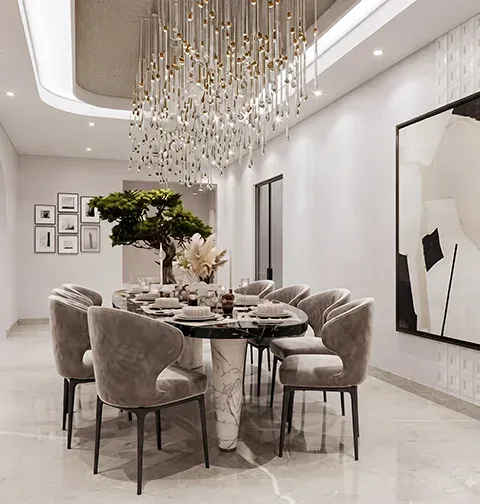
Purposeful restraint in materials. The finishes in a great boutique hotel aren't necessarily expensive, they're consistent. Stone, wood, linen, matte metals in two or three carefully chosen tones that speak the same visual language across every surface. There's no clash. Nothing competes. The restraint is what creates the sense of luxury.
Sound and scent as design elements. This gets almost no attention in home design but matters enormously in hospitality. The acoustic character of a room — whether it absorbs or reflects sound — affects how relaxing it feels. The way a space smells, whether through diffusers, wood finishes, or fabric choices, shapes your emotional response to it before you've consciously processed anything else.
Invisible functionality. Great hotel rooms hide their storage, their charging points, their cables, their minibar. The mechanics of living don't intrude on the experience of living. This is what the best interior design company in India calls "functional invisibility" — and it's one of the hardest things to achieve well.
Room by Room: Translating Hospitality Design into Your Home
The Bedroom — Where the Transformation Is Most Felt
If there's one room to start with, it's the bedroom. The principles are straightforward but rarely applied in residential design.
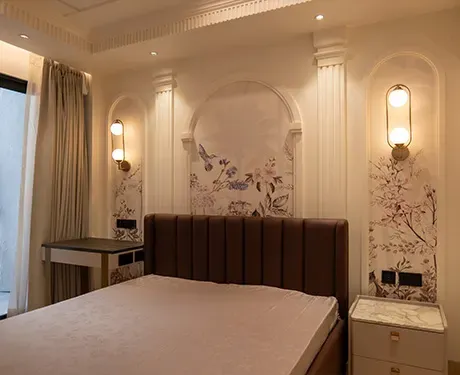
Go for a singular, considered headboard — full width, upholstered in linen or bouclé, tall enough to visually anchor the room. Layer the bed in whites and warm naturals with exactly one texture contrast — perhaps a muted herringbone throw or a subtle pattern in the cushions. Install a bedside pendant lamp or a wall sconce on each side instead of table lamps. Add a dimmer to every light circuit. Remove anything from the room that isn't genuinely necessary or beautiful.
The result, done properly, is a room you want to walk into — not just sleep in.
The Living Room — Conversation, Not Exhibition
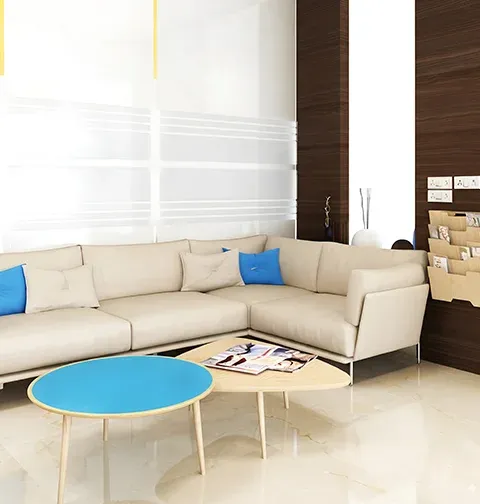
Most Indian living rooms are designed for display: sofas arranged around a television, a centre table that's never quite the right height, lighting that's bright enough to read a menu but kills any sense of atmosphere.
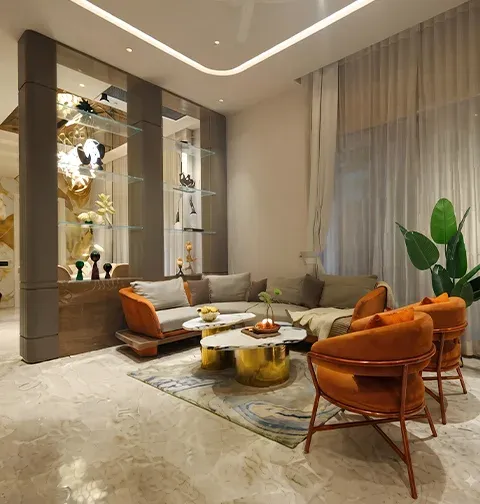
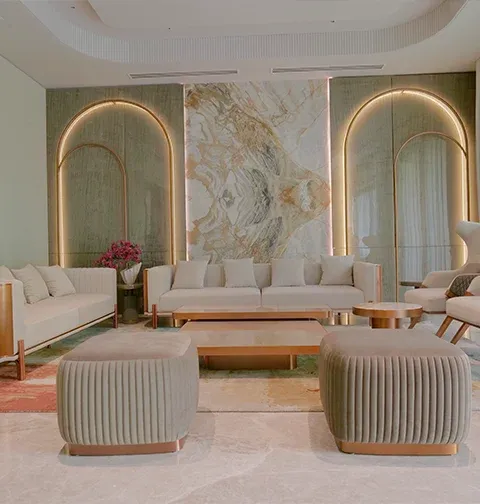
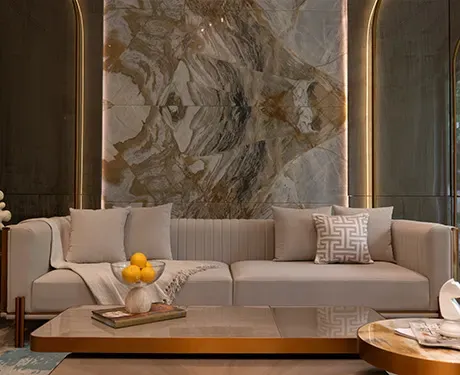
Boutique hotel lobbies and lounges solve this differently. Seating is arranged for conversation first, with television treated as an optional add-on rather than the focal point. Soft furnishings carry the warmth — textured cushions, thick rugs, curtains that pool slightly on the floor. A mix of seating heights creates visual interest and makes the space feel curated rather than showroom-bought. And the lighting, again, comes from multiple sources at eye level and below, never just from above.
The Bathroom — The Easiest Win
If you've ever wondered why hotel bathrooms feel so indulgent even before you've used anything in them, the answer is mostly material and spatial restraint. Large-format stone or porcelain on both floor and wall — consistent, not mismatched. A rainfall shower head positioned centrally. Recessed storage or floating vanities that eliminate the visual clutter of bottles and products. Warm lighting above and around the mirror, never just an overhead tube. Thick towels hung precisely.
None of these involve high-end plumbing. Most of them are purely design decisions.
The Entrance — The First Impression That Sets Everything
Luxury interior designers in India consistently say that the entrance is the most underdesigned space in Indian homes. It's usually a narrow corridor treated as a pass-through — shoe rack visible, lights blazing, walls bare.
A boutique hotel entrance does the opposite: it creates a moment of transition. A console table with one or two objects placed with intention. A mirror that makes the space feel larger. A coat hook or concealed wardrobe unit that tucks the mechanics of arrival out of sight. A single piece of art or a textured wall finish that signals you've entered somewhere considered.
This transition matters psychologically. It's the cue to your nervous system that you've arrived somewhere that cares about your experience.
Why Interia Brings This Vision to Life Better Than Anyone Else
Understanding the principles above and actually executing them well are two very different things. And this is where working with the right interior design firm in India becomes the deciding factor between a home that looks vaguely better and one that genuinely transforms how you live.
Interia has been creating luxury residential interiors since 2009. Founded by Umesh Kumar, an alumnus of IIT Delhi and IIM Bangalore, the firm has delivered over 500 projects across India and internationally, spanning luxury apartments in DLF Magnolias, premium villas at Prestige Golfshire in Bangalore, turnkey bungalows in Gurgaon, and even a sample apartment project in Nepal. That breadth of experience matters because it means Interia's team has seen, and solved, the full complexity of what luxury residential design actually demands in practice, not just in theory.
What makes Interia genuinely different among top interior designers in India is the combination of creative vision and operational rigour. Umesh Kumar's design leadership is paired with COO Shefali Agrawal, who brings corporate-grade project management to every project, previously having led teams at Publicis Sapient. The result is a firm where the design is ambitious and the delivery is reliable. In an industry where delays, miscommunication, and cost overruns are commonplace, Interia's clients consistently highlight the opposite experience.
Interia's philosophy is worth stating plainly: spaces should inspire and uplift. Not impress guests. Not signal wealth. Inspire — the person who lives there, every single day. That's a meaningfully different north star than the one most design firms operate with, and it shows in the work.
The firm's in-house manufacturing capability gives Interia an edge that's rare among even the best interior design companies in India. Every custom furniture piece is produced in-house by skilled artisans and passes through rigorous quality checks before installation. This means the bespoke sofa you approved in the design phase is the bespoke sofa that arrives in your home — not a near-match from a vendor who made substitutions without telling anyone.
Clients have described sitting in their newly completed rooms and feeling emotional — not because the space is ostentatious, but because it came out more beautiful than they had imagined possible. That outcome — the one that surprises even the client who briefed the project — is what Interia has spent fifteen years learning how to consistently produce.
You Don't Have to Check Out to Feel This Way
The feeling you get in a great hotel isn't something you have to leave behind when you get home. It's a design outcome: specific, replicable, and entirely achievable in a home that belongs to you.
Interia's team of luxury interior designers has been helping clients make exactly this transformation since 2009. If you're ready to start living every day in a space that genuinely feels like a permanent vacation, the first step is a conversation.
Book a design consultation with the Interia team — and find out what your home is actually capable of.
Q: Does bringing boutique hotel aesthetics into a home mean it'll look cold or impersonal?
Not if it's done properly. The warmth in great boutique hotels comes from texture, layered lighting, and scale, not from personalisation stripped away. A good luxury interior designer works your personality and lifestyle into the design brief. The result should feel deeply personal, just beautifully resolved.
Q: How do I know if my budget is suitable for this level of design?
Interia works across a range of project budgets starting from ₹30 lakhs, with full turnkey luxury projects often ranging between ₹1 crore and upward depending on scope and specification. The first consultation is the right place to align scope with budget honestly.
Q: Is this kind of transformation only possible in large homes?
No, and some of the most impressive transformations happen in compact apartments. Boutique hotel design is fundamentally about proportions, restraint, and considered material choices, all of which scale down beautifully. A 2BHK done with this level of intention can feel more luxurious than a 4BHK done without it.
Q: How long does a full residential project with Interia take?
Timelines depend on scope, but Interia has delivered full turnkey bungalow projects, including a 2,600-yard plot project in Gurgaon, within eight months. Standard apartment projects are typically completed on a defined schedule agreed at the outset.
Q: Can Interia work with my existing furniture and art, or does everything need to be new?
Yes, Interia works with existing pieces where they fit the design vision. During the briefing phase, the team assesses what's worth retaining, what needs to be repositioned, and where new investment will make the most impact.
Q: What sets Interia apart from other luxury interior designers in India?
Three things consistently: Umesh Kumar's IIT/IIM-trained design leadership, in-house manufacturing that guarantees quality from concept to installation, and a delivery track record across 500+ projects that proves the firm doesn't just design beautifully, it executes reliably. Interia has been covered in Financial Express, Outlook, Republic, Times Now, and other publications specifically for its role in helping India's luxury homeowners achieve world-class living standards at home.